
Sultan Al Qasimi witnesses the launch of the activities of the ninth session of the Sharjah Desert Theater Festival

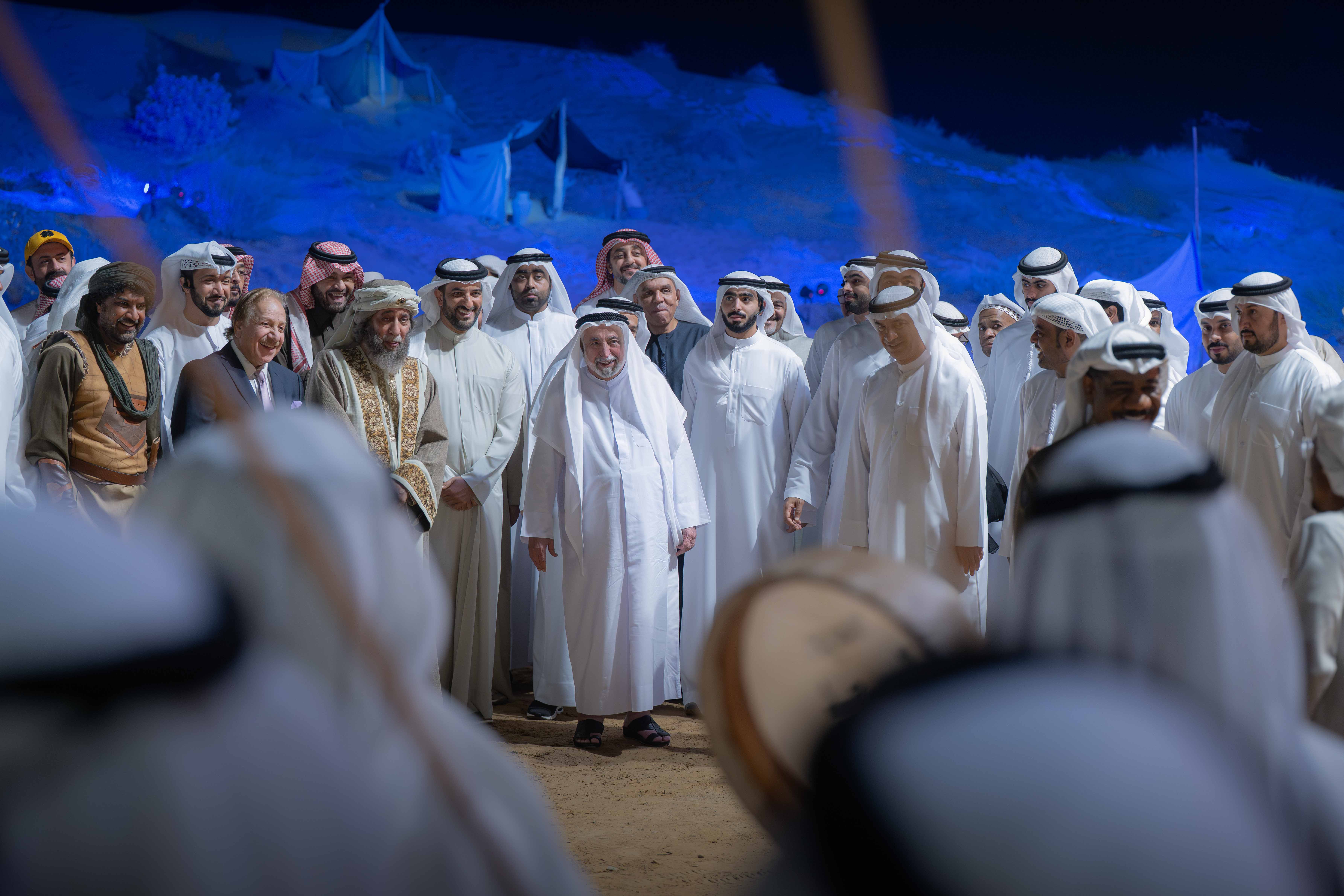
Sharjah, December 12, 2017 – His Highness Sheikh Dr. Sultan bin Muhammad Al Qasimi, Member of the Supreme Council and Ruler of Sharjah, witnessed this evening, in the presence of His Highness Sheikh Sultan bin Ahmed bin Sultan Al Qasimi, Deputy Ruler of Sharjah, the launch of the activities of the ninth session of the Sharjah Desert Theater Festival, which continues until December 17, and its first day witnessed a theatrical performance written by His Highness entitled “Al-Buraq and Laila Al-Afifa,” in the Al-Kahif area in Sharjah.
His Highness praised the performance of the actors, the script, and the application of poetic words and advanced techniques used in the theatrical show. His Highness pointed out that the idea, spectacle, and cinema show were added to the theatrical work, which is characterized by diversity in its components, stressing that the capabilities and desire of the Sharjah National Theater were available to produce the work in the name of the United Arab Emirates in this festival.
His Highness the Ruler of Sharjah confirmed that participating in the theatrical work “Al-Buraq and Laila Al-Afifa” aims to obtain the festival’s award, and to compete with various entries from Arab countries. His Highness explained that winning the award is not a personal title for His Highness or for Sharjah, but for the United Arab Emirates.
His Highness pointed out that the theatrical work “Al-Buraq and Laila Al-Afifa” differs from any previous work because it is based on competition and competition among the participating countries, praising the efforts of director Mohammed Al-Amiri, who confirmed his superiority by directing a large and complex work, his mastery of the performing arts, and the diversity between theatrical and pictorial acting, which reflects the mastery of the work.
His Highness the Ruler of Sharjah pointed out the importance of improving theater and having people who support and elevate it, noting that he is one of those who devoted themselves to theatre, since childhood, recalling His Highness in 1954 AD, when he directed a play whose message was so strong that its revenue reached 30 thousand rupees at that time. His Highness explained that it was not a coincidence, but rather it fell on an Eid day, and Eid in Sharjah people gather under the “Rolla Tree”, where tickets were sold there, describing They called for the great attendance presented by the sheikhs at that time. His Highness considered this reputation a resounding success for a theater led by young people, calling for rising above pettiness in theatrical work, and recommending the need to rally around all theater lovers.
His Highness spoke about the efforts led by the Sharjah Academy for Performing Arts in the field of supporting theatre, indicating that the academy will produce to the Arab world large numbers of talents and graduates with honed their skills from different countries. His Highness stressed that he will embrace them during the study period, and take their hand after graduation by supporting their ideas as they are young beginners in this field. His Highness pointed out that if the graduate does not receive attention, he will be lost, explaining that this step was discussed in the academy’s meetings to reach tangible results, stressing His Highness The numbers of members are large and all doors are open to all nationalities.
His Highness the Ruler of Sharjah stressed that theatrical work must be freed from narrow regionalism, calling for the importance of winning affection in this field, in order to elevate people, which leads to the advancement of theatre. His Highness advised the playwrights, writers and directors not to be drawn into trivialities and farcical works, and that theater must have a strong message, stressing that he was the first to encounter these challenges, at the end of the fifties and the beginning of the sixties when His Highness had a theatrical work and collided with the English representative at the time, who He was invited to perform a powerful theatrical performance, after which he requested that the theater be closed and the equipment confiscated, and the projects that His Highness had worked on were taken from plays he had written himself.
His Highness quoted from his speech at the UNESCO World Theater when he said, “When the English delegate saw the theater and the soldiers attacking him, his spirit fled and entered into him.” His Highness hoped that works in this field would be from people who have faith in what they say and credibility. His Highness advised writers, playwrights and directors of the need to develop themselves quickly, to be present among the adults and to raise the country’s flag among the international countries that organize competitions in the theatrical field.
Immediately upon his arrival at the site of the festival, which celebrates the Arab desert environments and highlights their customs, traditions and creative legacies through the aesthetics of theatrical art, His Highness watched the performances of the popular band and the heritage segments presented by them, which highlight the skill of the performers and their ability to employ heritage in crafting scenes that touch the conscience of the audience and enhance the connection to the cultural heritage.
His Highness, the Ruler of Sharjah, witnessed the new theatrical work written by His Highness, entitled “Al-Buraq and the Chaste Laila”, which embodies a distinctive story from the stories of Arab history preserved for us by the Diwan Al-Arab “Poetry”, through the poems that the poets wrote that sang the qualities of heroism, chivalry, courage, sincerity, dedication and love for this land. It is a wonderful inspiration from the stories of history that Arab poetry documented with poets’ rhymes that overflow with abundance and inspiring poetic images that have remained. Engraved in the conscience throughout the ages.
The theatrical work also relied on employing live expressive means and pictorial performances that enhance the strength of the scene and deepen the connection with the events, through the use of horses and camels, whose presence contributed to adding greater realism to the show, and translating poetic images into tangible scenes that touch the viewer’s feelings.
These visual elements formed a fundamental pillar in conveying the artistic and cultural message, due to their close connection to the authentic Arab environment, and their ability to embody the spirit of chivalry and valor that was addressed in the theatrical performance.
The show was presented by the Sharjah National Theater troupe, and many local and Arab acting stars participated in it, most notably Ahmed Al Jasmi, Bassem Yakhour, Ibrahim Salem, Abdullah Masoud, and Azza Zaarour, while the show was directed by director Mohammed Al Ameri.
This course comes under the title “Sahrawi Theater and the Aesthetics of Arab Folklore,” and aims to explore the artistic and technical possibilities offered by Arab folklore to enrich the desert theater experience and push it toward broader creative horizons.
The launch of the festival was attended by Sheikh Khalid bin Essam Al Qasimi, Head of the Department of Civil Aviation, Sheikh Mohammed bin Humaid Al Qasimi, Head of the Department of Statistics and Community Development, Sheikh Majid bin Sultan Al Qasimi, Head of the Suburbs Affairs Department, and a number of senior officials, artists and notables from the region.
- For more: Follow Khaleejion 24 Arabic, Khaleejion 24 English, Khaleejion 24 Live, and for social media follow us on Facebook and Related


