
Raising the retirement age in China increases pressure on younger workers

In the bustling industrial city of Tangshan in northern China, Lin Liang has been working in the maintenance department of a large mining company for 15 years.
He still has decades to go before he retires and receives a pension, which is longer than he had planned, due to a recent decision to raise the retirement age throughout China.
Facing a rapidly aging population, which threatens to bankrupt the country’s pension system, Beijing last year began implementing its first retirement age increase since the 1950s.
Younger workers like Liang will be affected the most, as the retirement age for men will be gradually raised from 60 to 63 years over the next few years, while the retirement age for women will be raised from 50 to 55 years for female employees, and from 55 to 58 years for female employees.
Although China’s legal retirement age is low by global standards, this change represents difficulty, especially for those young people who engage in physical labor or face greater job instability.
The contribution periods required of workers, that is, the period of time that workers or their employers must pay contributions to the retirement system in order to receive benefits, will also increase from 15 to 20 years between 2030 and 2039.
More expensive pensions
The contributions of Liang and others support a growing population of older Chinese. About 22% of China’s population is currently over 60 years old, and this number is expected to rise to 28%, or 402 million people, by 2040.
This trend is due to rising life expectancy and falling birth rates, which was exacerbated by the one-child policy that persisted in China for decades until 2016.
“If retirement ages are fixed and people live longer, pensions will become more expensive, and eventually the system will collapse,” says Nicholas Barr, professor of economics at the London School of Economics and Political Science.
“There should be an increase in the state retirement age,” adds Dr. Barr, who advised China on pension reforms from 2005 to 2010. “But that leaves a lot of other problems unresolved,” including the deep inequalities in China’s pension system and the difficult economic concessions needed to keep it funded.
A 2019 report by the state-run Chinese Academy of Social Sciences predicted that without reforms, the main government fund that finances future pensions would be exhausted by 2035.
Volatile job market
Wearing a crimson hat and traditional clothes, and beating a small drum, Qiao welcomes visitors to a small restaurant on a street crowded with vendors cooking traditional snacks, such as fried pastries, meat skewers and sesame pudding, in the city of Tangshan.
Qiao, who requested that his full name not be used to protect his privacy, worked for decades at a local chemical plant, doing grueling work that included chimney maintenance duties, before taking early retirement about eight years ago.
But Qiao can’t complain about his pension, which amounts to about 3,500 yuan a month (about $500). He increases his income by working as a receptionist in that small restaurant in his hometown. He says that he does not consider this work temporary, adding: “I want to be here…this work is fun.”
With his guaranteed pension, Qiao is better off than many workers, young and old, who worry about whether they can find a job in a volatile labor market, says Dr. Qian Huang, a professor of comparative politics at Rutgers University in Canada, who researches China’s social welfare system.
Inequality
Of the more than a billion Chinese who participate in the system, about 534 million people fall under a plan for urban employees and retirees, like Qiao, which in 2023 paid beneficiaries about 3,742 yuan a month ($537).
However, 538 million rural residents, including mobile workers and urban workers, are eligible for a much less generous plan, which in 2023 paid about 223 yuan per month ($32). This reflects the fundamental inequality in Chinese society between rural and urban communities.
Civil servants and other government employees receive larger pensions, currently estimated at between 6,000 and 7,000 yuan per month, according to a 2025 report by the Mercator Institute for China Studies in Berlin.
Declining population
It is noteworthy that official data issued recently showed that China’s population will decline, for the fourth year in a row, in 2025, with the birth rate declining to a new record level, with experts noting that this decline will continue in the coming years.
The National Bureau of Statistics said that the total population in China decreased by 3.39 million people to reach 1.405 billion people in 2025, which is a faster decline than in 2024, while the total number of births decreased to 7.92 million births in 2025, a 17% decrease from 9.54 million births in 2024. About “Christian Science Monitor”
The next generation
Mining plant worker Lin Liang is not enthusiastic about changing the retirement age, but accepts it as necessary to maintain the pension system.
“For the younger workers, what matters is the amount of their salaries and retirement benefits,” he says, standing under a winter sky near the Tangshan Mining Company’s factory. “We have to think about the next generation, and not be too selfish, but when the time comes for the next generation to retire, their pensions will largely depend on where they were born and live.”
. Raising the retirement age for men from 60 to 63 years. For women, the age was raised from 50 to 55 years for female employees, and from 55 to 58 years for female employees.
. Increase the period of time that workers or their employers must pay retirement contributions to receive benefits, from 15 to 20 years between 2030 and 2039.
Regional differences
Retirees feel frustrated after their health care benefits are cut. Reuters
Dr. Qian Huang, professor of comparative politics at Rutgers University in Canada, says: “We have witnessed a growing sense of injustice and a decline in confidence in the social welfare system in China.”
He adds that people believe their economic well-being is determined by regional differences, tax systems and other factors, not by how hard they work.
Frustrated, retirees have protested cuts to their health care benefits made by local governments in recent years.
Recognizing the political sensitivity of pension reform, China’s government is moving slowly to address the issue, despite increasing demographic and economic pressures.
Beijing first proposed the idea of raising the retirement age more than 10 years ago.
Beijing aims to replace the decentralized and regional administration of pensions with a national system by 2035, but its goals of expanding pension coverage and maintaining the comprehensiveness of the system conflict with the priority of achieving strong economic growth and creating job opportunities.
Ultimately, “China needs to reduce spending on pensions over time,” says Dr. Nicholas Barr, who has advised China on pension reforms.
Punishing young people
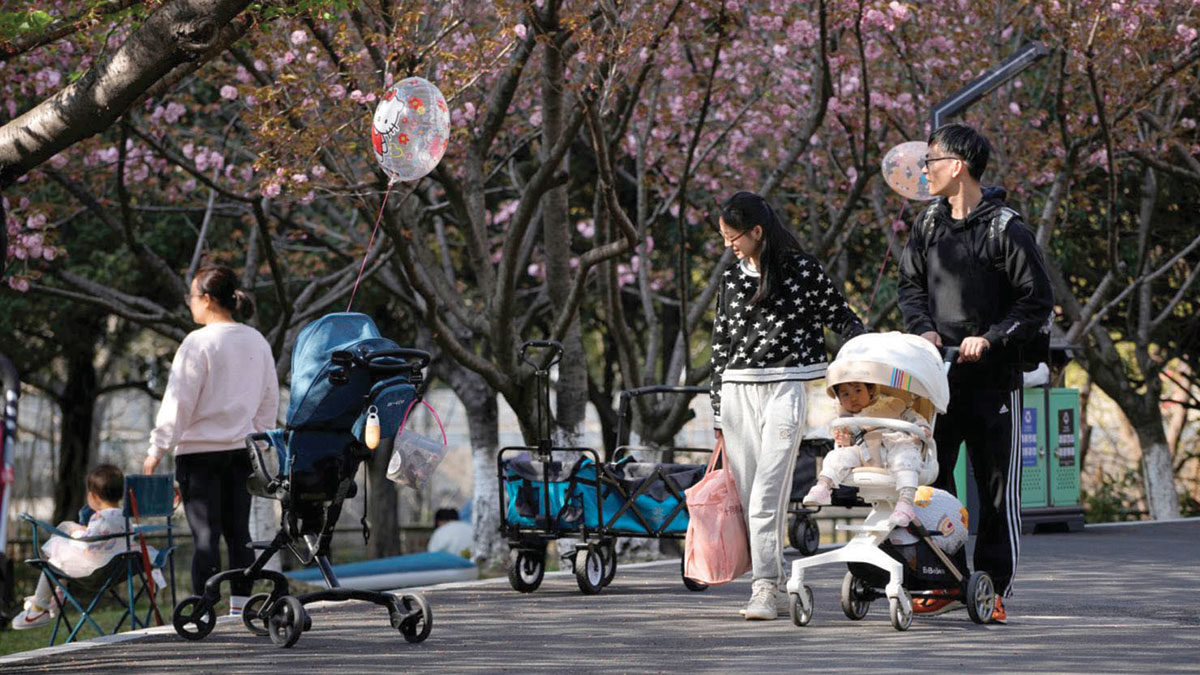
The unemployment rate among Chinese youth has approached 20% since the spread of the Corona epidemic in late 2019. Some people in their fifties are also working overtime to support their families and meet pension contribution requirements.
The decision to raise the retirement age sparked criticism and controversy on social media, where discussions about pension reform collide with “disagreement over responsibility and cost-sharing” between workers and companies.
Some comments indicated that the change is unrealistic and penalizes young people, while others doubted that private companies would hire older workers, noting that Chinese technology companies regularly lay off workers over the age of 35. One social media user asked: “Tell me, what are we supposed to do during the remaining 30 years of our lives?”
- For more: Follow Khaleejion 24 Arabic, Khaleejion 24 English, Khaleejion 24 Live, and for social media follow us on Facebook and Twitter


