
"House of Wisdom" It embodies Sharjah’s vision of cultural innovation and promoting sustainable knowledge

Sharjah, 19 May / WAM / The “House of Wisdom” and the “Manuscript” monument, which were launched by the Sharjah Investment and Development Authority “Shurooq” on the occasion of the selection of the Emirate of Sharjah as World Book Capital for the year 2019 by UNESCO, together represent an integrated vision for developing cultural projects, as the first symbolizes the moment of global recognition, while the second translates this recognition into a sustainable daily experience.
With this approach, Shurooq succeeded in transforming a cultural achievement into a living cognitive structure that confirms that architecture can be a tool for sustaining meaning.
At first glance, the “House of Wisdom” in Sharjah appears to be a contemporary library with an elegant design, but what is not apparent to the visitor at first glance is a complex architectural and engineering system designed to redefine how knowledge is accessed and used.
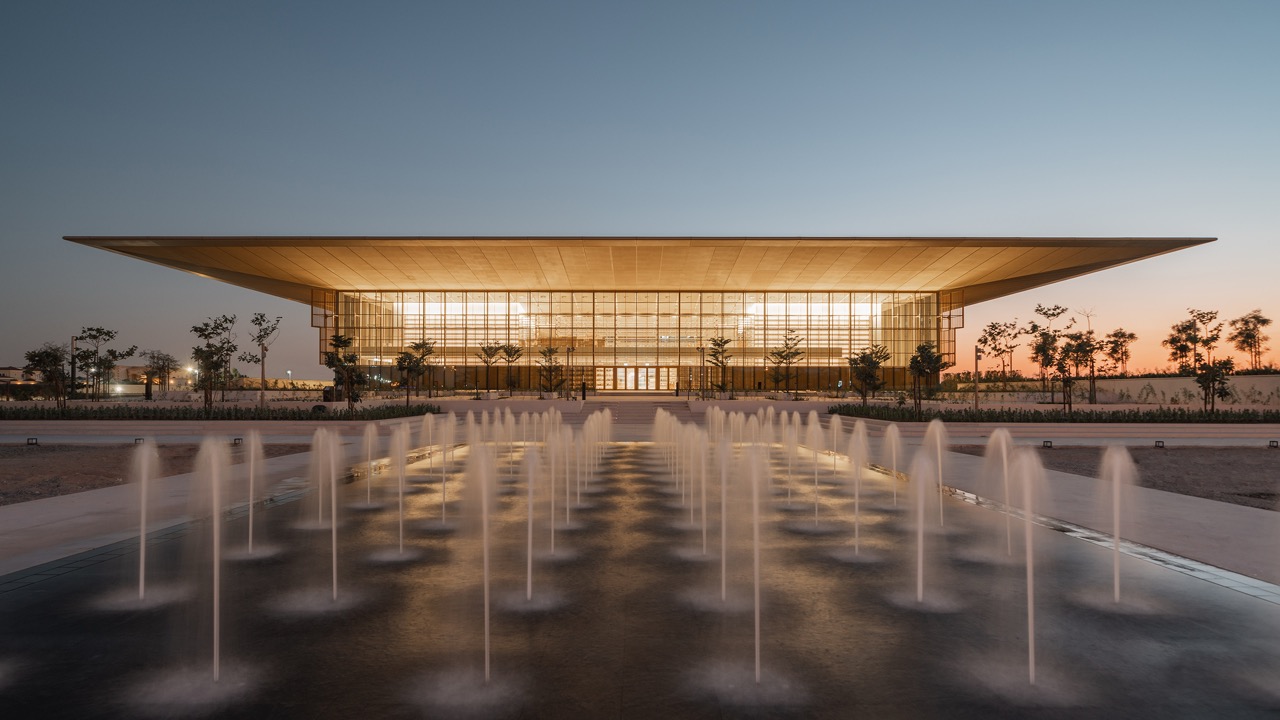
The building is based on only four structural cores that carry a ceiling extending for a distance of 15 metres, which provides internal spaces completely free of columns and gives the user freedom of movement and visual openness that is unusual in traditional libraries.
Also, the natural light inside the “House of Wisdom” is not the result of traditional openings, but rather the result of an integrated lighting control system, where facades covered with aluminum screens of varying density filter sunlight, while internal movable bamboo screens allow for adjusting the level of light and privacy without cutting off the visual connection with the surrounding gardens.
The extended roof, which appears to float above the building, forms the first line of defense against direct sunlight, ensuring the protection of books, files, and cognitive content inside the building, while at the same time enhancing the efficiency of environmental performance.
All of these details are not separate design treatments, but rather part of an integrated vision led by Shurooq to transform the “House of Wisdom” into a living knowledge environment that embodies the Emirate of Sharjah’s approach to consolidating its position as a global center for culture and knowledge.
The story began with the “Manuscript” monument, which came as the first visual expression of Sharjah’s selection as World Book Capital for the year 2019 by UNESCO, but for Shurooq, the goal was not to stop at a symbol that commemorates the achievement, but rather to move beyond.
Instead of being satisfied with a teacher being seen, a basic question was asked: How can the idea of knowledge be transformed into a daily experience that people live with? The answer was “The House of Wisdom.” The project was opened in 2020 as a permanent cultural and community center that embodies the transfer of knowledge from a symbol to a practice and from a moment of celebration to a continuous system.
The “House of Wisdom” includes more than half a million titles between paper and digital sources, but its design was not built on the idea of storage, but rather on how to use knowledge. The building includes lecture halls, discussion spaces, exhibition areas, and laboratories for manufacturing and modeling, in addition to flexible learning environments that respond to different learning styles.
The distribution of spaces reflects a precise understanding of users’ behavior, as open spaces that encourage interaction are integrated with quiet reading corners that allow concentration, while facilities such as the “Ladies’ Lounge” came in direct response to users’ needs in terms of privacy and comfort. Braille books were also integrated into the main collection, which reinforces the principle of equal access to knowledge without separation or classification.
To embody this vision, Shurooq cooperated with international architecture office Foster + Partners to develop an architectural model that reflects the role of the House of Wisdom as a contemporary knowledge institution. The design was based on a disciplined engineering system based on balance and symmetry, while drawing inspiration from the principles of Islamic architecture in a modern style that focuses on clarity of mass and organization of spaces.
The inner courtyard is a pivotal element in regulating light and movement inside the building, as it allows natural light and air to enter deep into the spaces and contributes to improving the quality of the indoor environment, in addition to its role in regulating movement and creating stopping points within the user experience.
The building also opens visually to its natural surroundings, as the interior spaces overlook carefully designed gardens that include a knowledge garden and an area designated for children, in addition to an engineering garden that houses the “Manuscript” monument in direct visual connection. During the day, the building is characterized by calm and discipline, while at night it transforms into a luminous mass from which knowledge emanates outward in a visual expression that reflects the idea of sharing knowledge.
Khawla Sayed Mohammed Al Hashemi, Executive Director of Projects at Shurooq, confirmed that the project was based on understanding the nature of knowledge today, and we did not begin by designing a building, but rather we began by defining how to access knowledge and how it is used within an integrated environment.
She added that it is easy to create a landmark, but the real challenge is to design a place that people will constantly return to and that will become a part of their daily lives, noting that the success of “House of Wisdom” is measured by the rates of use, the length of time visitors stay, and the diversity of activities it embraces.
She explained that this philosophy is not limited to the House of Wisdom, but rather constitutes an integrated approach followed by Shurooq in its various projects and destinations, where all development processes are based on key pillars that include sustainability, innovation, preserving identity and enhancing the role of society. This comes within the framework of the strategic directives and vision of Sheikha Bodour bint Sultan Al Qasimi, Chairwoman of Shurooq, which focuses on developing quality projects that combine cultural value and long-term societal impact.
- For more: Follow Khaleejion 24 Arabic, Khaleejion 24 English, Khaleejion 24 Live, and for social media follow us on Facebook and Related


